
Innovative solutions for security
SD-WAN or MPLS—which is the right choice for your enterprise? Explore the differences in architecture, performance, security, reliability, cost, cloud connectivity, and centralized management. Learn how SD-WAN, MPLS, and hybrid WAN strategies help organiz
SD-WAN vs. MPLS: Choosing the Right WAN Strategy for Modern Enterprises
Building Secure, Reliable, and Application-Aware Enterprise Connectivity
Enterprise Wide Area Networks (WANs) connect headquarters, branch offices, data centers, cloud platforms, remote locations, and business-critical applications.
As organizations increasingly adopt cloud services, SaaS applications, unified communications, hybrid working models, and distributed infrastructure, traditional WAN architectures face growing demands for flexibility, visibility, and operational efficiency.
Two important technologies in enterprise WAN discussions are Multiprotocol Label Switching (MPLS) and Software-Defined Wide Area Networking (SD-WAN).
MPLS has long supported enterprise private WAN connectivity through provider-managed services and traffic engineering capabilities.
SD-WAN introduces centralized policy management, application-aware traffic steering, encrypted overlays, and the ability to combine different transport networks.
However, selecting the right WAN strategy requires more than comparing technologies. Organizations must evaluate business requirements, application performance, security, availability, operational complexity, and total cost of ownership.
At Pruthvija Technologies, we focus on enterprise connectivity architectures that balance network reliability, security, scalability, and operational efficiency.
This article explains the differences between SD-WAN and MPLS and provides practical guidance for selecting an enterprise WAN architecture.
1. What Is MPLS?
Multiprotocol Label Switching (MPLS) is a packet-forwarding technology that uses labels to direct traffic through an MPLS-enabled network.
In enterprise environments, MPLS is commonly delivered through telecommunications providers as managed Layer 3 VPN or Layer 2 VPN connectivity.
How MPLS Works
MPLS-enabled routers forward traffic using labels rather than performing a conventional destination IP lookup at every hop.
Typical components include:
-
Customer Edge (CE) routers
-
Provider Edge (PE) routers
-
Provider core routers
-
Label distribution mechanisms
-
MPLS VPN services
-
Quality of Service policies
-
Routing protocols such as BGP and OSPF
A provider-managed MPLS VPN can connect multiple enterprise sites through a shared service-provider backbone while maintaining logical separation between customer networks.
Advantages of MPLS
-
Provider-managed private WAN connectivity
-
Defined service-level agreements, where contracted
-
Traffic prioritization through supported QoS services
-
Established enterprise connectivity models
-
Suitable for latency-sensitive applications
-
Predictable operational responsibilities
Limitations of MPLS
-
Higher circuit costs in some markets
-
Longer provisioning times for certain locations
-
Limited flexibility when expanding into new regions
-
Additional design requirements for direct cloud access
-
Dependence on carrier service availability
MPLS remains a viable solution for enterprises that require specific provider-managed connectivity characteristics.
2. What Is SD-WAN?
Software-Defined Wide Area Networking (SD-WAN) is an architecture that centrally manages and controls WAN connectivity across multiple transport networks.
Unlike a WAN design that relies primarily on static routing decisions, SD-WAN platforms can monitor transport performance and apply application-aware forwarding policies.
SD-WAN can operate over:
-
Broadband internet
-
Dedicated internet access
-
MPLS circuits
-
LTE and 5G
-
Ethernet WAN services
-
Other supported IP transport networks
Key SD-WAN Components
SD-WAN Edge: A physical or virtual device that connects enterprise sites to the SD-WAN fabric.
Controller / Orchestrator: Provides centralized configuration, policy distribution, and operational management.
Secure Overlay Tunnels: Establish logical connectivity between participating sites, commonly using encrypted tunnels.
Application-Aware Routing: Selects traffic paths based on application requirements and measured network conditions.
Centralized Monitoring: Provides visibility into link health, application performance, and WAN connectivity.
Advantages of SD-WAN
-
Centralized network management
-
Flexible transport selection
-
Application-aware traffic steering
-
Dynamic path failover
-
Support for direct internet breakout
-
Cloud and SaaS connectivity optimization
-
Simplified branch policy deployment
-
Potential WAN transport cost optimization
SD-WAN performance and security capabilities vary by vendor, platform, licensing, and deployment architecture.
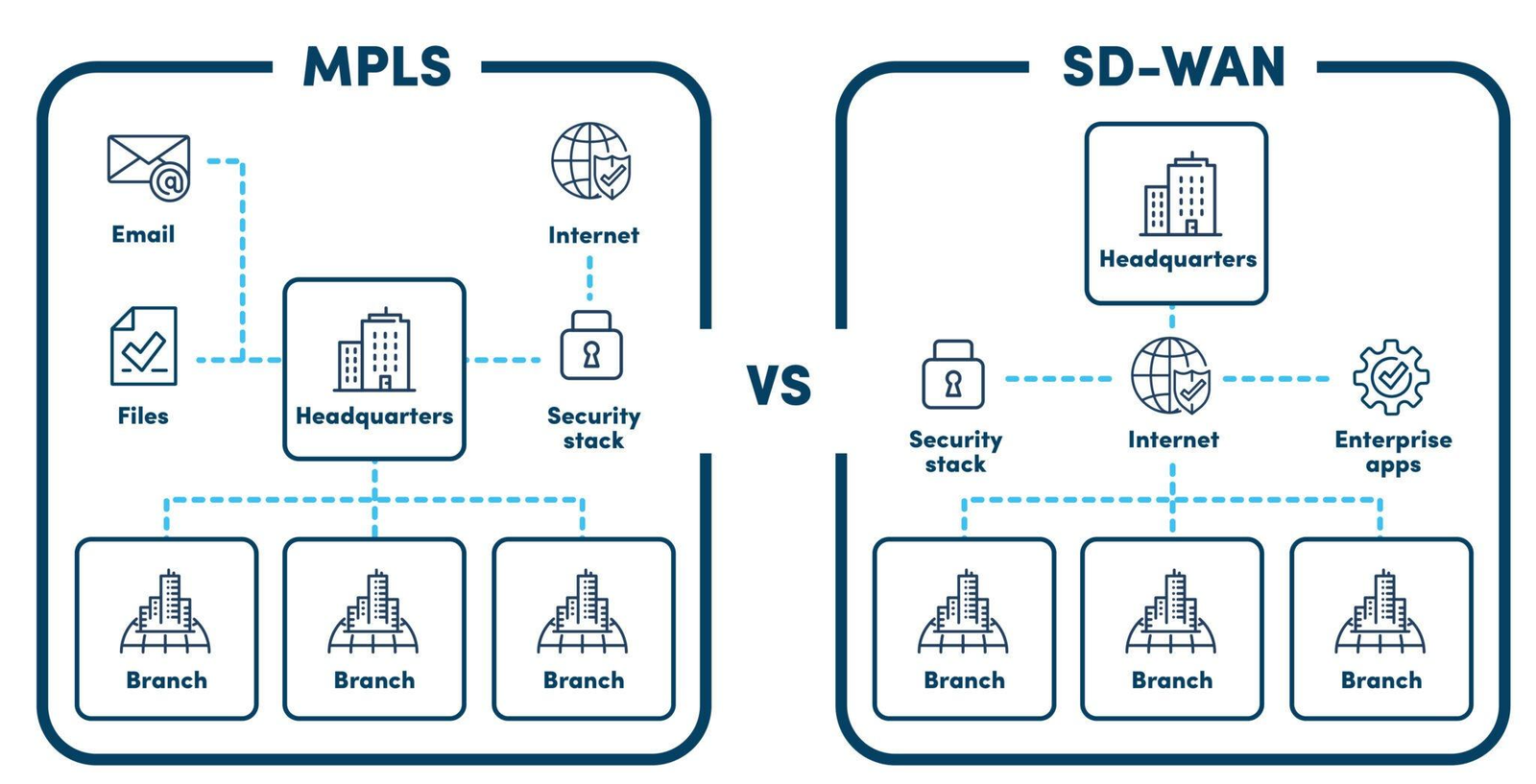
3. Architecture: Traditional MPLS WAN vs. SD-WAN
Traditional MPLS WAN Architecture
A conventional enterprise MPLS WAN may connect branches to a centralized data center or headquarters.
Example:
Branch Offices → MPLS Provider Network → Headquarters / Data Center
This model supports centralized application access and can simplify security enforcement when traffic passes through a central inspection point.
However, sending all cloud-bound traffic through headquarters can increase latency and consume WAN bandwidth.
SD-WAN Architecture
An SD-WAN deployment can connect branches through multiple WAN transports.
Example:
Branch Office → Internet / MPLS / 5G → SD-WAN Overlay → Headquarters, Data Center, Cloud, and Other Branches
SD-WAN policies determine which traffic uses each available transport.
For example:
-
Business-critical ERP traffic may use a preferred high-quality path.
-
Video conferencing may use a link with acceptable latency, jitter, and packet loss.
-
SaaS applications may use approved local internet breakout.
-
Backup traffic may use a lower-priority transport.
Best practice: Design WAN connectivity around application requirements rather than selecting a transport technology first.
4. Performance and Application-Aware Routing
Application performance is one of the most important factors in WAN architecture.
MPLS Performance
Provider-managed MPLS services may offer defined traffic classes and service-level objectives.
This can be valuable for:
-
Voice communication
-
Video conferencing
-
Financial applications
-
ERP systems
-
Transaction processing
-
Critical enterprise services
However, performance depends on the actual provider SLA, network design, circuit capacity, and end-to-end application path.
SD-WAN Performance
SD-WAN platforms can continuously evaluate transport conditions.
Common performance measurements include:
-
Latency
-
Jitter
-
Packet loss
-
Link availability
-
Application reachability
Based on configured policies, the SD-WAN platform may steer applications toward a transport that meets defined performance thresholds.
Example
An enterprise branch has:
-
MPLS: 100 Mbps
-
Dedicated Internet: 200 Mbps
-
5G: Backup connectivity
The SD-WAN solution may prefer MPLS for a selected private application, use internet connectivity for approved SaaS traffic, and switch affected traffic to an alternative path during degradation.
Important: SD-WAN cannot guarantee the quality of an unreliable internet connection. It can only use the available paths and platform capabilities to improve traffic handling.
5. Security: MPLS vs. SD-WAN
Security must be considered independently of the transport technology.
MPLS Security
Provider-managed MPLS VPNs offer logical traffic separation within the service-provider network.
However, MPLS VPN separation does not automatically provide end-to-end encryption.
Sensitive data may still require IPsec, application-layer encryption, or other security mechanisms.
SD-WAN Security
Many SD-WAN platforms provide encrypted overlay connectivity and centralized security policies.
Depending on the solution, capabilities may include:
-
IPsec tunnel encryption
-
Application-aware policies
-
Network segmentation
-
Firewall integration
-
Secure internet breakout
-
Cloud security integration
-
Identity-aware controls
-
Centralized policy management
Some SD-WAN solutions integrate with Secure Access Service Edge (SASE) architectures.
Best Practice
A secure WAN strategy should combine:
-
Strong encryption
-
Segmentation
-
Firewall policies
-
Secure device administration
-
Centralized authentication
-
Security logging
-
Threat detection
-
Regular configuration reviews
Neither MPLS nor SD-WAN should be treated as a complete security solution on its own.
6. Cloud and SaaS Connectivity
Cloud adoption has significantly changed enterprise WAN traffic patterns.
Traditional applications were often hosted in centralized data centers.
Modern enterprises increasingly use:
-
Microsoft 365
-
Microsoft Azure
-
Amazon Web Services
-
Google Cloud
-
Salesforce
-
Collaboration platforms
-
SaaS-based business applications
MPLS-Based Connectivity
An MPLS network can provide cloud access through provider cloud connectivity services or enterprise data center gateways.
However, centralized internet breakout may introduce unnecessary traffic backhauling.
SD-WAN Cloud Connectivity
SD-WAN can support direct internet breakout from branches and integration with cloud networking services.
Potential benefits include:
-
Reduced traffic backhauling
-
Improved SaaS path selection
-
Flexible cloud access
-
Centralized connectivity policies
-
Better visibility into application traffic
Direct internet access must still be protected using appropriate firewall, DNS security, web filtering, and other controls.
Best practice: Evaluate cloud application traffic patterns before deciding where internet breakout and security inspection should occur.
7. High Availability and WAN Redundancy
Business-critical networks require resilient connectivity.
MPLS Redundancy
Common approaches include:
-
Dual MPLS circuits
-
Multiple provider connections
-
Redundant CE routers
-
Dynamic routing
-
Diverse physical paths
-
Provider service resilience
SD-WAN Redundancy
Common approaches include:
-
Dual internet links
-
MPLS and internet combinations
-
LTE/5G backup
-
Dual SD-WAN edge devices
-
Dynamic path monitoring
-
Automated traffic steering
-
Centralized health monitoring
Important Design Consideration
Two WAN links do not necessarily provide true physical redundancy.
Both circuits may share the same building entry, last-mile fiber route, carrier infrastructure, or upstream dependency.
Best practice: Validate physical path diversity, device redundancy, routing convergence, and application continuity during planned failover testing.
8. Cost Comparison and Total Cost of Ownership
WAN costs vary significantly by geography, carrier availability, bandwidth, and service requirements.
MPLS Cost Considerations
-
Private circuit recurring charges
-
Bandwidth upgrades
-
Router equipment
-
Provider-managed services
-
Redundant circuits
-
Contractual SLA requirements
SD-WAN Cost Considerations
-
SD-WAN hardware or virtual appliances
-
Software subscriptions and licenses
-
Controller or management services
-
Internet and other transport circuits
-
Security subscriptions
-
Implementation and migration
-
Monitoring and operational support
SD-WAN may reduce transport costs when suitable internet services replace some private WAN capacity.
However, savings are not guaranteed.
Best practice: Compare three- to five-year total cost of ownership rather than evaluating monthly circuit charges alone.
9. Hybrid WAN: Combining SD-WAN and MPLS
For many enterprises, a hybrid WAN architecture provides a practical migration strategy.
A hybrid WAN combines multiple transport types under centralized traffic policies.
For example:
Headquarters: MPLS + Dedicated Internet
Branch Office A: MPLS + Broadband
Branch Office B: Dual Internet
Remote Site: Internet + 5G Backup
An SD-WAN overlay can use these transports according to application policies and network conditions.
Benefits of Hybrid WAN
-
Protects existing MPLS investments
-
Enables gradual SD-WAN adoption
-
Supports application-based traffic steering
-
Provides additional path diversity
-
Improves WAN visibility
-
Allows phased cloud connectivity modernization
A hybrid WAN can be particularly useful when enterprises operate sites with different connectivity requirements and carrier availability.
10. SD-WAN Vendor and Platform Considerations
Several enterprise technology vendors provide SD-WAN solutions.
Examples include:
Cisco Catalyst SD-WAN: Centralized SD-WAN policy, secure overlays, application-aware routing, and integration with Cisco networking ecosystems.
Fortinet Secure SD-WAN: Combines SD-WAN functionality with FortiGate security capabilities and centralized management options.
Palo Alto Networks Prisma SD-WAN: Provides application-aware WAN capabilities and integration with broader security offerings.
Huawei SD-WAN: Supports centralized enterprise WAN management and orchestration through compatible Huawei management platforms, including iMaster NCE solutions.
HPE Aruba Networking EdgeConnect SD-WAN: Provides WAN optimization, application-based path control, and centralized orchestration capabilities.
Vendor selection should consider platform interoperability, security architecture, operational requirements, licensing, support arrangements, and total cost.
11. SD-WAN Migration Strategy
Moving from a traditional MPLS WAN to SD-WAN requires a structured migration approach.
Phase 1: WAN Assessment
Review existing topology, bandwidth utilization, applications, routing, security policies, and provider dependencies.
Phase 2: Target Architecture Design
Define the SD-WAN overlay, underlay transports, controller placement, routing integration, and segmentation.
Phase 3: Pilot Deployment
Deploy a limited number of sites to validate routing, application performance, security, and operational workflows.
Phase 4: Hybrid Integration
Integrate existing MPLS services with the SD-WAN architecture where appropriate.
Phase 5: Branch Migration
Migrate sites in controlled phases with approved maintenance windows and rollback procedures.
Phase 6: Performance Validation
Test application connectivity, link failover, routing convergence, internet breakout, and security enforcement.
Phase 7: Documentation and Handover
Prepare network diagrams, HLD, LLD, routing plans, security policies, monitoring procedures, and acceptance reports.
12. How to Choose the Right WAN Strategy
Consider MPLS When:
-
Applications require specific provider-managed service guarantees.
-
Private WAN connectivity is a business requirement.
-
Existing MPLS services provide acceptable performance and value.
-
Carrier-managed connectivity is preferred.
-
Operational simplicity is more important than transport flexibility.
Consider SD-WAN When:
-
The organization operates multiple branches.
-
Cloud and SaaS traffic is increasing.
-
Centralized policy management is important.
-
Multiple WAN transports are available.
-
Application-aware path selection is required.
-
WAN automation and visibility are priorities.
Consider Hybrid WAN When:
-
Existing MPLS investments must be preserved.
-
Different sites have different connectivity needs.
-
The organization wants phased WAN modernization.
-
Private and internet-based transport services must coexist.
-
A gradual migration reduces operational risk.
13. How Pruthvija Technologies Can Help
At Pruthvija Technologies, our enterprise WAN and SD-WAN services focus on secure connectivity, infrastructure resilience, centralized management, and multi-vendor integration.
Our service capabilities include:
-
Enterprise WAN assessment and consulting
-
MPLS and SD-WAN architecture design
-
Cisco, Fortinet, Huawei, and multi-vendor integration
-
SD-WAN deployment and migration planning
-
Branch network connectivity
-
Application-aware routing design
-
WAN high availability and redundancy
-
Secure internet breakout
-
Firewall and network security integration
-
Cloud and data center connectivity
-
Performance monitoring and optimization
-
HLD, LLD, testing, and technical handover
Our approach focuses on selecting WAN architectures aligned with application requirements, business continuity objectives, and long-term network growth.
Conclusion
SD-WAN and MPLS both have important roles in modern enterprise networking.
MPLS continues to provide valuable provider-managed private WAN connectivity, while SD-WAN introduces flexible transport utilization, centralized policy management, application-aware routing, and improved operational visibility.
For many organizations, a hybrid WAN architecture offers an effective balance between existing infrastructure investments and future connectivity requirements.
The right WAN strategy is the one that delivers the required application experience, security, resilience, operational manageability, and business value.
Pruthvija Technologies — Connecting Enterprises. Securing Networks. Enabling Digital Transformation.
Ready to Modernize Your Enterprise WAN?
Contact Pruthvija Technologies to discuss SD-WAN deployment, MPLS integration, WAN optimization, secure branch connectivity, and enterprise network moderniz